
The Art of Self-Care: Yangsheng 養生, Nourishing Life
Sunny-Kim Barden
3/22/2026
Welcome to In Eastern Med blogs! My inspiration for writing blogs stemmed from a desire to share and expand on the health-related conversations I've had with my patients. As a practitioner of Traditional East Asian medicine, namely Traditional Korean medicine, in the United States, the beliefs and attitudes about health, wellness and treatments from an eastern perspective are foreign and odd to most Americans unless they've been exposed to other cultures that respect and preserve the empirical wisdom of traditional or folk medical practices. Western medicine or modern biomedicine has evolved to focus on isolating a disease or symptoms and treating the isolated disease or symptoms. Whereas, whole medical systems like Traditional East Asian medicine looks at the interconnectedness of the mind, body and spirit, the whole person, and aims to treat the whole person. My blogs will touch on health-related topics that cover not only physical disorders, but imbalances of a social, psychological, and environmental nature that affect the physical.
A good number of my patients first approached me not because they were seeking acupuncture or holistic medicine, but because they had exhausted all conventional options, felt worse and alienated by today's high tech, low-touch impersonal managed health(sick)care system constantly being shuffled from one office to another. Today's visit to the doctor's office is often anxiety-provoking for many people who get a diagnosis which feels like a life-death sentence, "You have ABC and if you don't take this Rx, you'll --XYZ." Traditional East Asian Medicine which I will interchange with eastern medicine is low tech, high touch and can be very personal. For instance, Eastern medical practitioners commonly ask patients about bowel movements and the quality of your poop which may seem odd to Americans. As an eastern medical practitioner, I feel the pulses, irregularities of tissues and ask patients personal questions in order to know you, your condition, thoroughly.
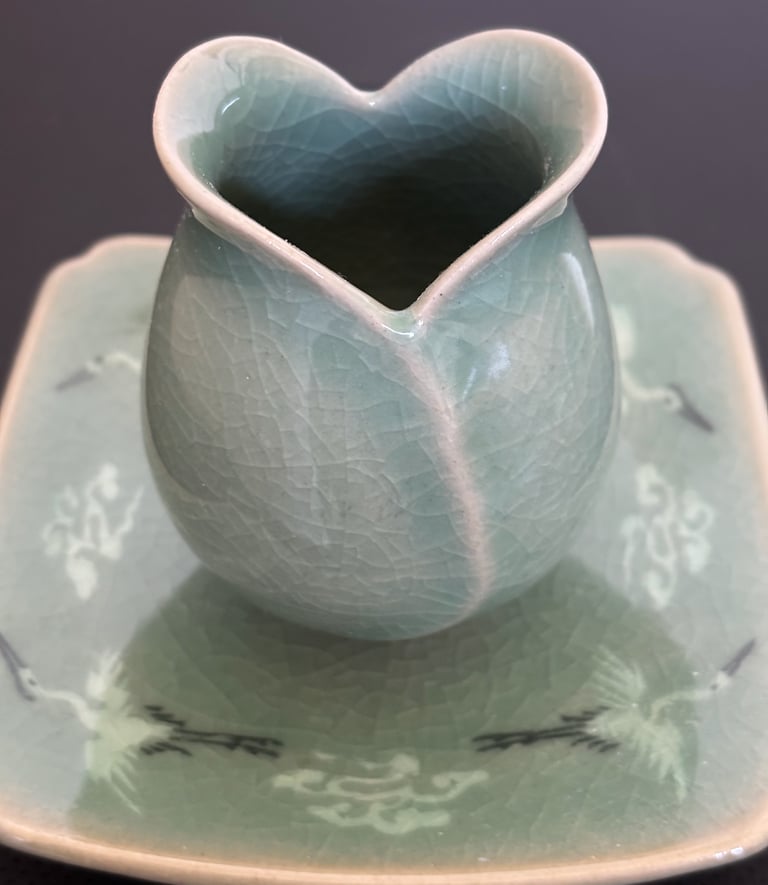
The image of the Korean celadon tea cup and saucer above is shaped in the form of a lotus bud with images of cranes and clouds on the saucer. A dear friend, also a Korean acupuncturist, gave me this exquisite handmade, traditional celadon tea cup. One day while enjoying my tea, I noticed the open heart shape of the lotus bud which inspired me to create a blog that will share experiences that are personal because life and health are very personal. We are all going through this thing called the human condition and are sojourners while on the earth. For myself, the art and enjoyment of tea requires quality time to be present, good tea, good company and connection, intangible gifts that enrich life. So I write my first blog about the art of self-care which is known as yangsheng 養生 which translates as "nurturing or preserving life."
The premise of yangsheng 養生 is that life is precious or health is wealth and vice versa. If you think about it, you and your life are unique. Through the life force of nature, you came into being. There is no one else like you. Therefore, nurturing life or self-care merits your time and investment on a regular basis. In Chinese/Korean, the two characters comprising the word for health (Chinese 健康 jian-kang/Korean 건강 gun-gang) mean foundation and build. Without good health, there's no foundation to life. One of the most famous quotes eastern medical practitioners often share is from the Yellow Emperor's Classic of Internal Medicine (Huang Di Nei Jing 黃帝內經, circa 250 BCE): "To fight a disease after it has occurred is like trying to dig a well when one is thirsty, or forging a weapon once a battle has begun." A healthy life is a disciplined lifestyle. Good health isn't instant as the latest infomercials for supplements and gadgets lead us to believe.
The purpose of yangsheng which is synonymous with preventive self-care is to maintain health and prevent illnesses while enjoying a long life. A painful conversation I've had repeatedly with patients who have struggled with numerous illnesses is it was only when they became seriously ill that they realized the value of good health. I've come to value good health after witnessing my father's suffering and recovery from a severe stroke when he was 46 years old. Fortunately, he relied on and had access to regular acupuncture treatments and herbal medicine, along with physical therapy and healthy homemade Korean meals my mother prepared. He was a rare stroke-hemiplegic case that made a full recovery in mobility and speech. Looking back, I believe if my father had made lifestyle modifications (self-care investments) a few years before the stroke, such as eating less sodium and more vegetables, and exercising regularly, he most likely could have avoided a stroke. However, he had to make major investments and sacrifices to rebuild his health or life foundation after suffering a stroke. He counted his blessings and considered himself fortunate that he was living and had family who encouraged him during the rebuilding of his health. He was always grateful to God for the knowledge of self-care practices, access to a skilled acupuncturist and the daily health improvements as well as the health challenges he experienced. I am fortunate to have witnessed my father's healing process and understand the pricelessness of life and good health as well as the effort it takes to improve and maintain one’s health.
In eastern cultures that have preserved traditional practices, self-care is paramount to maintaining health. In societies that rely heavily on modern technology and managed healthcare systems, people rely on medical practitioners to provide treatments that will fix health problems. The art of self-care is unfortunately forgotten in such societies. The responsibility of health is shifted onto multiple third parties, such as insurance companies, lobbyists, politicians, medical providers, pharmaceutical manufacturers to name a few. Individuals in modern societies that rely on managed healthcare systems feel disempowered. I will share examples of cases how people lose their health and how to rebuild and nurture life in future blogs. My blogs will introduce principles and practices of self-care that East Asian cultures still practice today. I've shared some of these simple self-care practices with patients and these practices have not only empowered them but their health has improved as a result. I hope these experiences and conversations will touch your heart and mind, and inspire and empower you to be more in control of your health.
Contact Sunny
323-863-6109
ineasternmed@gmail.com
Copyright © 2026 In Eastern Med. All Rights Reserved.
DISCLAIMER: This website is for informational purposes only. Before attempting any natural or holistic practices, it is strongly encouraged that you seek professional medical advice from a licensed healthcare professional. Any communication through this site is for informational purposes only and does not constitute the establishment of a doctor-patient relationship.