
Did you say "CHEE" (Qi)?
The importance of producing Qi for health
3/21/2026
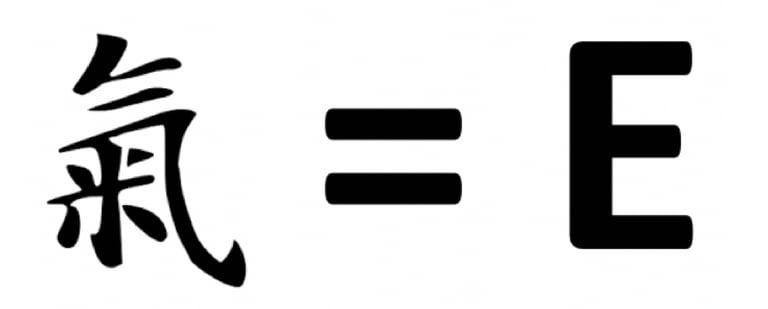
Whenever the term Qi, 氣 (pronounced “chee” in Chinese), is used, it brings up a sense of mystique, intrigue, and frankly confusion for many Westerners new to East Asian terms and concepts. Even among acupuncturists and scholars of Chinese in the U.S., there’s an ongoing debate on the definition(s) of Qi still to date. However there’s no debate in Asia regarding Qi’s various meanings, applications and contextual uses as the various meanings have been known and accepted. Qi is often used as a root word or morpheme that makes up many terms as in the case of the English morpheme bio (life) as in biography, biology, antibiotic, symbiotic and so on and so on. For those interested in Japanese and Korean, the same character for Qi (氣) is pronounced “kee” in Japanese (き) and Korean (기).
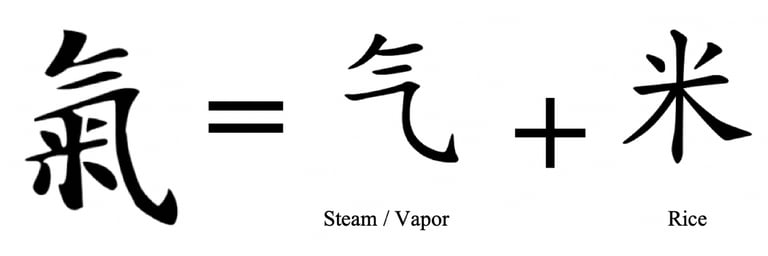
George Soulié de Morant, a French diplomat and scholar, is either credited or criticized for translating 氣 (Qi) as l’énergie to the western world. We know today that energy has many forms and meanings, not just one absolute energy form in a vacuum. I side with the translation of Qi having a basic meaning of energy which can then be applied to many contexts. If Albert Einstein were alive today, I believe he would have appreciated the significance of Qi. We now know there are at least six forms of energy we can observe, measure and use in our world, namely chemical, nuclear, electrical, mechanical, thermal, and radiant. Einstein’s special theory of relativity E= mc^2 confirms energy and mass are the same physical entity and interchangeable. Similarly, the character Qi is made up of two radicals, where the top radical signifies steam or vapor, while the bottom radical signifies rice as shown in the illustration below. All organisms consume substances like rice which have mass and humans convert the substances into energy units called adenosine triphosphate (ATP) via chemical processes through the digestive system and cellular respiration.
So why should we care about Qi? As an acupuncturist, I use needles to stimulate the body’s innate healing responses. In more scientific terms, acupuncture needles stimulate the movement of qi / energy through a phenomenon called piezoelectricity which can be interpreted as another form of Qi. Piezoelectricity is the production of electrical charges within body tissues like fascia and tendons when stimulated by acupuncture needles. In addition, acupuncture can release fascial tension and improve structural/ musculoskeletal balance. The mechanical stress from the needles on collagen fibers generates electrical energy, potentially stimulating beneficial cellular responses, reducing inflammation, and relieving pain. For patients who desire a more natural healing approach and less medications, acupuncture is a safe and effective therapy that stimulates the complex mechanisms of Qi.
The importance of building Qi for health: Who doesn’t want to be healthier and have more energy? However, not everyone is willing to be poked with needles. If that’s the case with you, you can still build Qi for health on your own through daily breathing exercises. Remember that our bodies convert food resources into ATP (chemical energy), the unit of energy for activity. We have three energy-converting systems, the Phosphagen, Anaerobic glycolysis, and Aerobic systems which produce varying amounts of ATP. Approximately, the Phosphagen system produces 1 ATP per molecule, the Anaerobic Glycolysis system produces 2-3 ATP per glucose molecule, and the Aerobic system produces approximately 32-38 ATP per glucose molecule. That’s right, the aerobic system produces the most ATP energy units. If the aerobic system produces the most ATP units, it's in our best interest to stimulate the aerobic system. The thought of doing aerobic exercises may be daunting to you. You may be wondering if you lack the energy to perform aerobic exercises, how can you stimulate your aerobic system? There are high impact aerobic exercises but there is another way to stimulate the aerobic system without doing high impact exercises. So the aerobic system requires enough oxygen intake which I will call Qi to produce another form of Qi (ATP). The term aerobic suggests oxygen is required. One of the reasons why we feel tired is that many people today are stressed and forget to breathe properly to stimulate the aerobic system with breathing. When we are stressed, most of us default into shallow chest breathing.
I recommend an easy breathing exercise to my patients wishing to boost their metabolism and have more energy. In East Asian medicine, this breathing exercise is called dantian breathing which is foundational in Qigong and Tai Chi. Dantian breathing is synonymous with diaphragmatic breathing using East Asian terms. You can do this exercise every morning in bed. Set aside 10 minutes for this breathing exercise. You can set your alarm 10 minutes earlier. Upon waking, lie on your back and place one hand on your chest, and the other hand below your navel and notice your breathing. The goal of this exercise is to engage your diaphragm muscle so that your belly inflates with inhalation. This will increase oxygen intake and stimulate the vagus nerve for reducing stress. If the hand that’s on your chest is moving, you know that your diaphragm is not engaged. With diaphragmatic breathing, you want your chest to be still and your lower abdomen to rise with your diaphragm muscle. Inhale through your nose and exhale with your lips slightly pursed producing a hissing sound. The exhalation needs to be extended and your abdominal muscles contract slightly during exhalation. For instance, if you inhale on a count of 3 seconds, your exhalation should be 7 to 10 seconds long. This breathing exercise provides a gentle massage of the organs in your abdominal cavity from the undulation of the diaphragm muscle contracting and relaxation and as a result can help make your bowel movement more regular.
Contact Sunny
323-863-6109
ineasternmed@gmail.com
Copyright © 2026 In Eastern Med. All Rights Reserved.
DISCLAIMER: This website is for informational purposes only. Before attempting any natural or holistic practices, it is strongly encouraged that you seek professional medical advice from a licensed healthcare professional. Any communication through this site is for informational purposes only and does not constitute the establishment of a doctor-patient relationship.